
The transition towards clean energy is no longer simply an environmental aspiration—it is becoming an important component of modern infrastructure, industrial competitiveness and long-term energy resilience. Our Solar Energy Solutions are designed to help industries, commercial establishments, institutions, residential communities and infrastructure projects progressively reduce their dependence on conventional power sources while improving energy efficiency and operational sustainability.
We provide end-to-end solar energy solutions, integrating system design, engineering, installation, commissioning, monitoring and maintenance. From rooftop solar installations to large-capacity commercial systems and hybrid or off-grid configurations, our approach focuses on matching the energy-generation architecture with the client’s actual consumption pattern, operational requirements and future expansion plans.
Our objective is straightforward: convert available sunlight into dependable, economically viable and environmentally responsible energy.

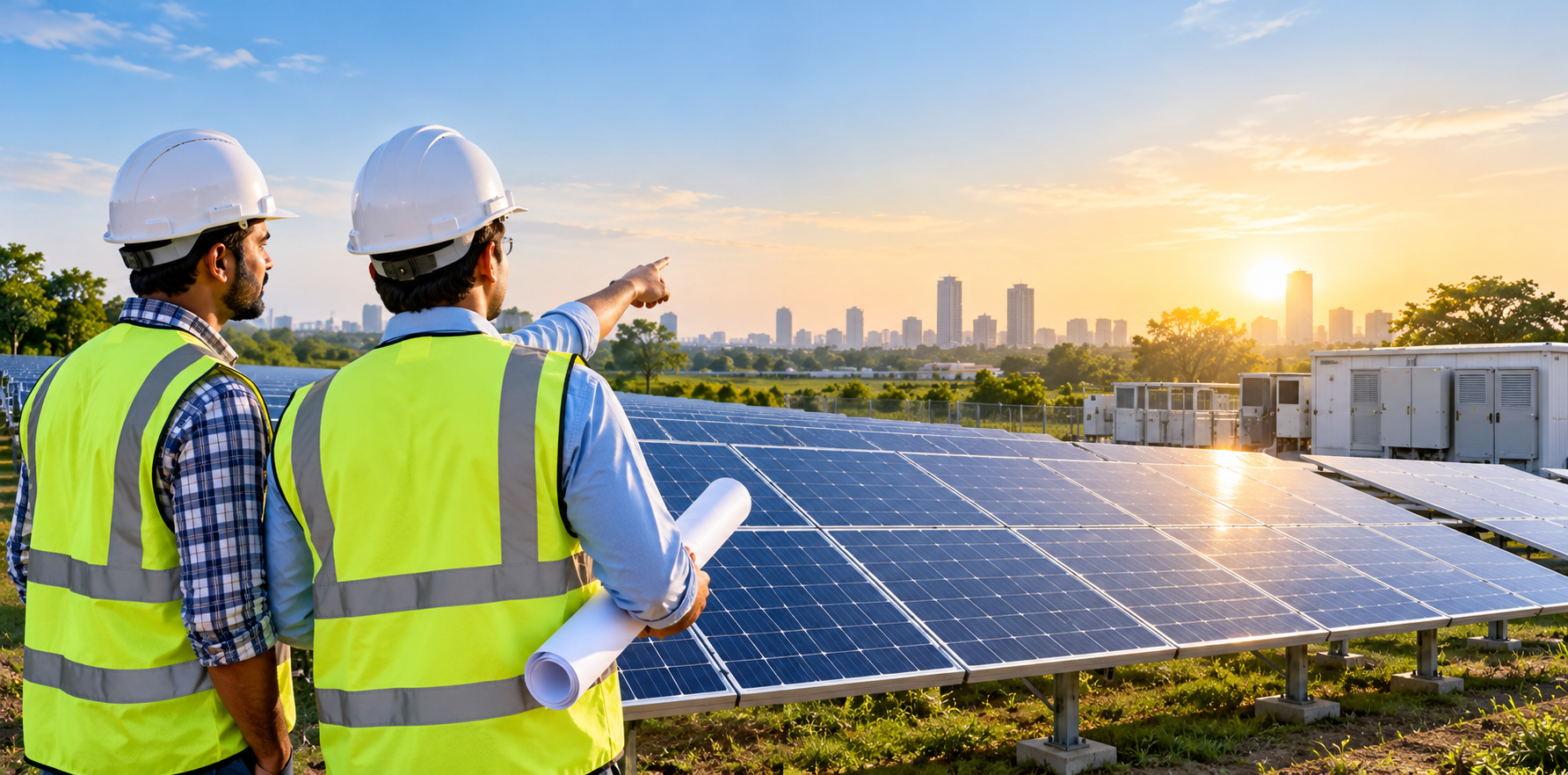
A successful solar project requires much more than installing photovoltaic panels. System capacity, roof or land availability, solar irradiation, electrical loads, structural conditions, energy consumption patterns, backup requirements, grid connectivity and future demand all need to be considered.
Our turnkey approach brings these elements together under an integrated project framework.
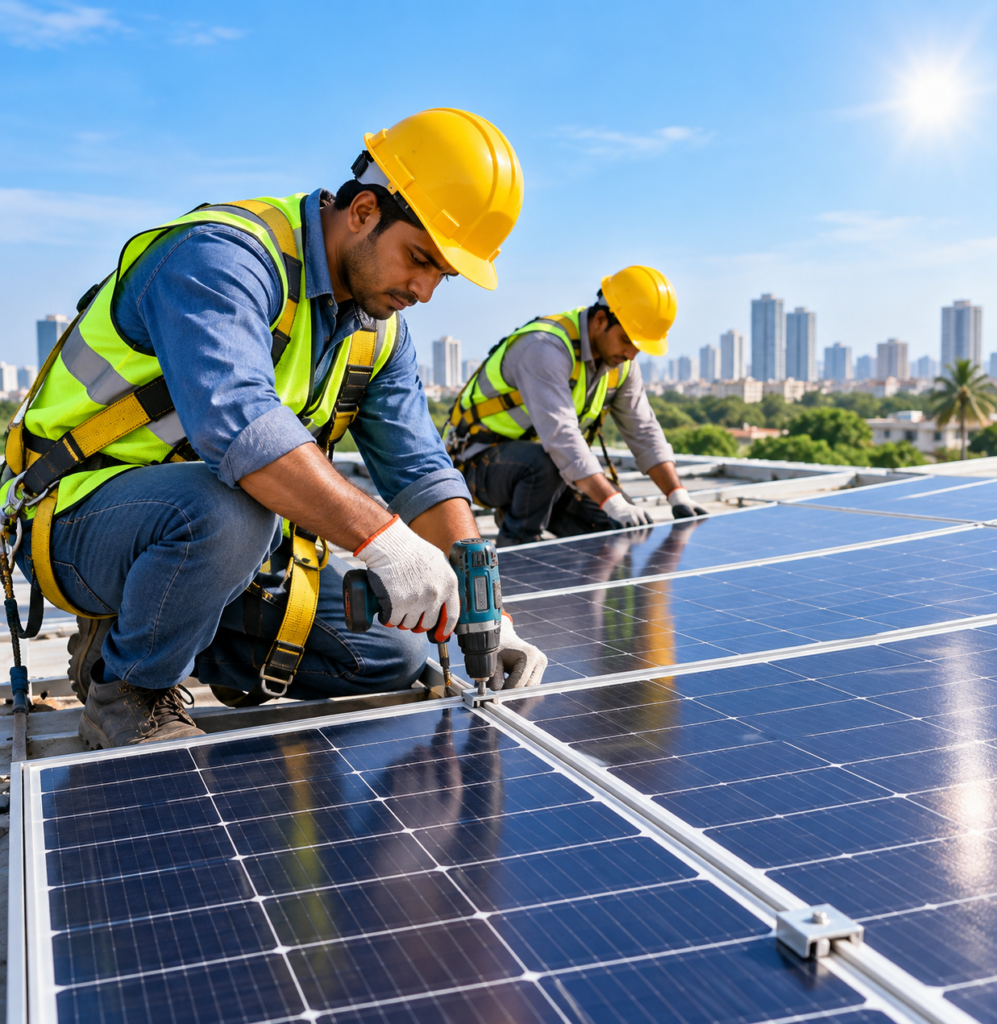
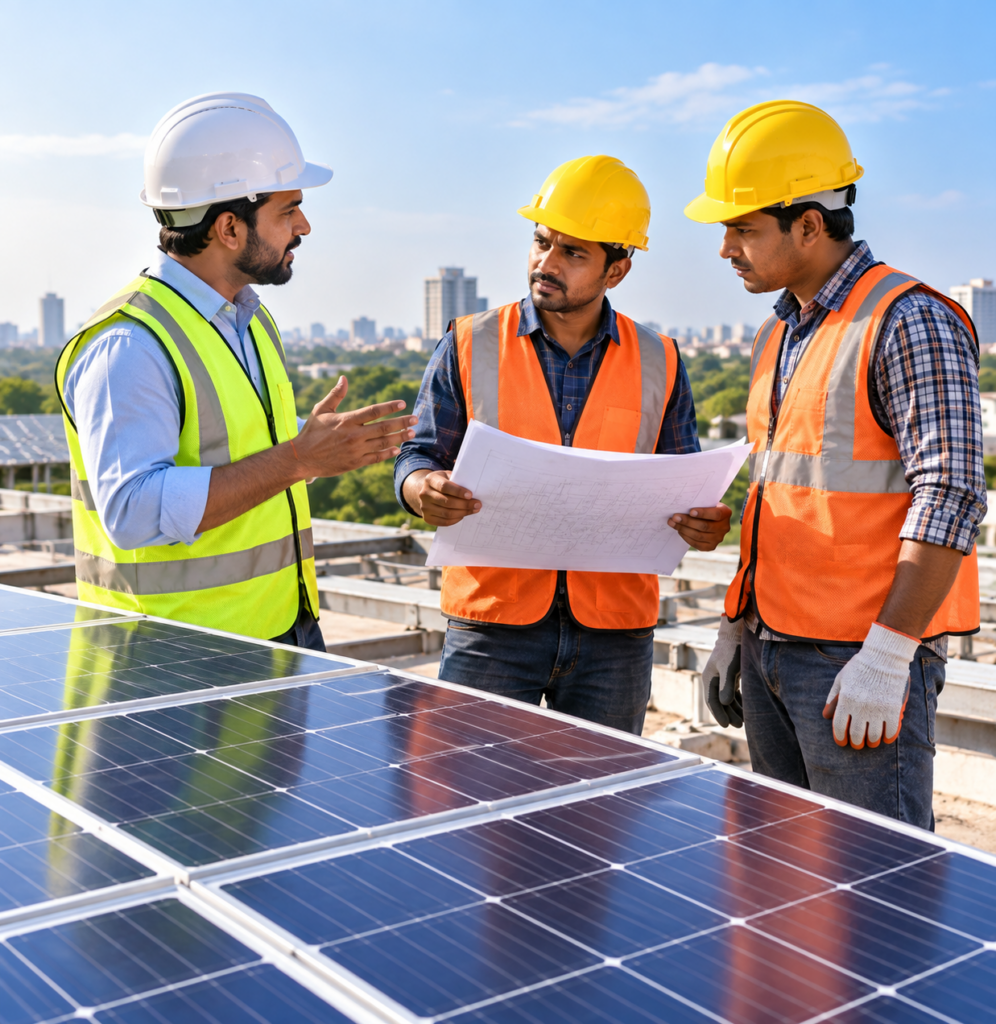
Commercial and industrial facilities often operate with substantial and predictable electricity requirements. Warehouses, manufacturing units, educational institutions, hospitals, hotels, office campuses, shopping facilities, housing complexes and other large establishments can potentially utilise available rooftops, parking areas or suitable land for solar generation.
Our systems can be configured according to the operational profile of the facility.
Industrial Facilities
Solar systems can supplement daytime industrial electricity consumption and contribute to reducing dependence on conventional grid electricity.
Commercial Buildings
Office buildings, business parks, retail establishments and commercial complexes can utilise rooftop solar to support their common and operational energy requirements.
Institutional Campuses
Schools, colleges, universities, training centres and public institutions can integrate solar generation with broader sustainability programmes.
Healthcare Facilities
Hospitals, clinics and healthcare campuses can explore solar generation alongside appropriate backup and energy-management systems.
Residential Communities
Apartment complexes, housing societies and gated communities can deploy solar systems for common-area electricity, water pumping, lighting and other shared requirements.
Infrastructure Projects
Solar power can complement lighting, communication, monitoring, pumping and other distributed infrastructure applications.
For locations with reliable grid connectivity, grid-connected solar PV systems can enable consumers to generate electricity locally while remaining connected to the conventional power network.
Solar generation can be designed around the facility’s daytime consumption profile, helping maximise the utilisation of locally generated renewable electricity.
Depending on applicable regulations, utility policies and project configuration, systems may also be designed to accommodate mechanisms such as net metering or other permitted grid-interaction arrangements.
Our role is to help clients evaluate the technical configuration and project requirements so that the solar installation integrates effectively with the existing electrical infrastructure.
Some locations cannot depend exclusively on the electricity grid. Remote facilities, rural infrastructure, field installations, communication sites, agricultural operations and critical facilities may require greater energy autonomy.
For such applications, we can develop off-grid and hybrid solar architectures combining solar generation with suitable energy-storage and backup technologies.
A hybrid system may integrate:
Solar PV + Battery Storage + Grid + Backup Generator
or, where appropriate:
Solar PV + Battery Storage + Off-Grid Load Management
Such configurations can be designed to prioritise renewable generation while maintaining an appropriate level of operational resilience.
The objective is not simply to produce solar electricity but to develop an energy architecture appropriate to the reliability requirements of the site.
Solar generation and energy storage can work together to create a more flexible energy-management system.
Battery Energy Storage Systems (BESS) can potentially store surplus solar electricity for later use, subject to system design, battery technology, load characteristics and economic considerations.
Storage can be configured to support selected loads during periods when solar generation is unavailable, including evening hours or temporary grid interruptions.
Our design philosophy is to size storage according to actual operational requirements rather than simply adding battery capacity without a defined use case.
Every site is different. A system designed for a manufacturing plant cannot simply be replicated on an institutional campus or residential complex.
Our engineering process therefore considers multiple parameters before recommending a configuration.
Energy Consumption
Historical electricity bills and load patterns help establish the facility’s actual energy requirements.
Peak Demand
Understanding peak electrical demand is important for determining system architecture and grid-interaction requirements.
Available Area
Rooftop dimensions, land availability, structural capacity and access conditions influence system design.
Solar Orientation
Panel orientation, tilt and shading conditions affect generation potential.
Electrical Infrastructure
Existing transformers, distribution boards, protection systems and cabling must be evaluated for appropriate integration.
Backup Requirements
Critical loads may require battery storage, generator integration or another backup arrangement.
Future Expansion
Where possible, the system architecture can account for anticipated increases in electricity demand.
Solar energy can become part of a broader sustainable-infrastructure strategy rather than functioning as an isolated technology.
A well-planned project can combine:
Solar Generation
↓
Energy Efficiency
↓
Energy Storage
↓
Smart Monitoring
↓
Responsible Consumption
↓
Reduced Conventional-Energy Dependence
This integrated approach helps organisations move from simply consuming energy towards actively managing how energy is generated, stored and utilised.
Installing a solar system is the beginning of its operational life—not the end of the project.
Regular monitoring and maintenance can help identify performance deviations, equipment faults, soiling, shading issues, electrical abnormalities and other operational concerns.
Our maintenance approach may include:
Digital monitoring systems can also provide useful information regarding electricity generation and system performance, enabling operators to identify deviations and undertake timely intervention.
Electricity is a significant operating expense for many organisations. Solar generation can provide an opportunity to diversify the energy mix and potentially reduce exposure to conventional electricity costs.
However, the financial viability of each project depends on factors such as:
We therefore encourage a project-specific financial assessment rather than relying on generic payback assumptions.
Where appropriate, project analysis can examine:
Capital Investment → Annual Generation → Electricity Offset → Operating Cost → Savings Potential → Payback Period → Long-Term Value
The clean-energy transition represents a fundamental shift in the way organisations think about power.
Instead of depending entirely on electricity generated elsewhere, organisations can progressively develop distributed renewable-energy capacity closer to the point of consumption.
Solar energy provides a particularly important pathway because sunlight is widely available and photovoltaic systems can be deployed across a wide range of scales.
Our approach is centred on three interconnected principles:
01 — Generate
Harness available solar resources through appropriately engineered photovoltaic systems.
02 — Optimise
Use energy intelligently through monitoring, load management, efficient equipment and appropriate storage.
03 — Sustain
Maintain the system throughout its operational life to preserve performance, reliability and environmental value.
Our clean-energy philosophy extends beyond the installation of photovoltaic modules.
A truly sustainable energy project considers the complete ecosystem around energy generation and consumption.
This includes:
Solar power therefore becomes one component of a broader resource-efficiency and sustainability framework.
For organisations pursuing comprehensive environmental programmes, solar energy can be integrated with other green infrastructure initiatives.
Potential combinations include:
Solar + Green Buildings
Solar + Rainwater Harvesting
Solar + Organic Waste Management
Solar + Water Conservation
Solar + Sustainable Landscaping
Solar + Electric Mobility
Solar + Energy-Efficient Lighting
Solar + Smart Facility Management
This integrated model can transform individual infrastructure projects into more resource-efficient and environmentally responsive facilities.
STEP 1 — DISCOVER
Understand the site, energy demand, operational requirements and project objectives.
STEP 2 — ASSESS
Evaluate solar potential, available space, electrical infrastructure, structural considerations and consumption patterns.
STEP 3 — DESIGN
Develop an appropriate solar architecture, including generation capacity, electrical integration, storage and backup requirements where applicable.
STEP 4 — ENGINEER
Prepare the technical configuration, equipment specifications, electrical architecture and installation methodology.
STEP 5 — INSTALL
Execute installation and integration with appropriate quality-control and safety procedures.
STEP 6 — COMMISSION
Test the system, verify performance and integrate monitoring and operational protocols.
STEP 7 — MONITOR
Track generation, system performance and operational parameters.
STEP 8 — MAINTAIN
Implement preventive and corrective maintenance to support long-term system performance.
WhatsApp us